Shahid Anwar

How I teach

Student-centred approaches I use to get every student thinking, talking and doing mathematics.

Below are the five strategies I use most in each area. Most lessons combine several of them: a retrieval starter, a collaborative task, a quick check, then tiered practice.

Thinking together

Students learn mathematics by doing it with each other: talking, testing ideas and explaining their reasoning out loud.

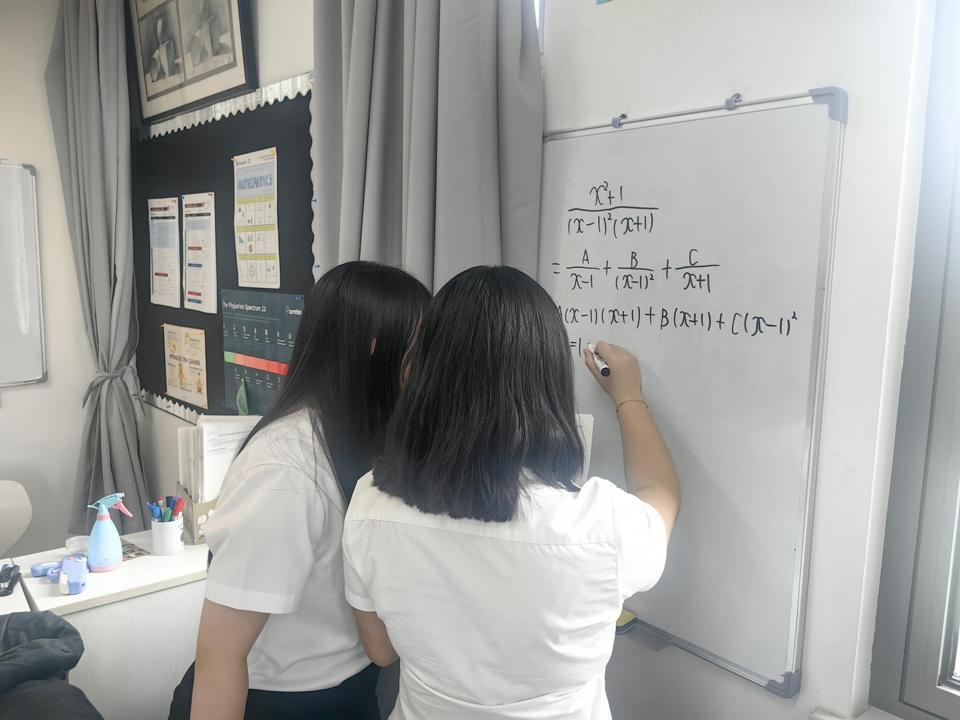
Two students working on a wall whiteboard

Vertical whiteboards

What it looks like
Small groups solve problems standing at wall-mounted whiteboards, with one marker shared between them.
Why it works
Standing and erasable surfaces make students start sooner, take more risks and keep their thinking visible to me and to other groups.

In my classroom: groups of three work through partial fractions on the wall boards while I move between them asking “How do you know?”
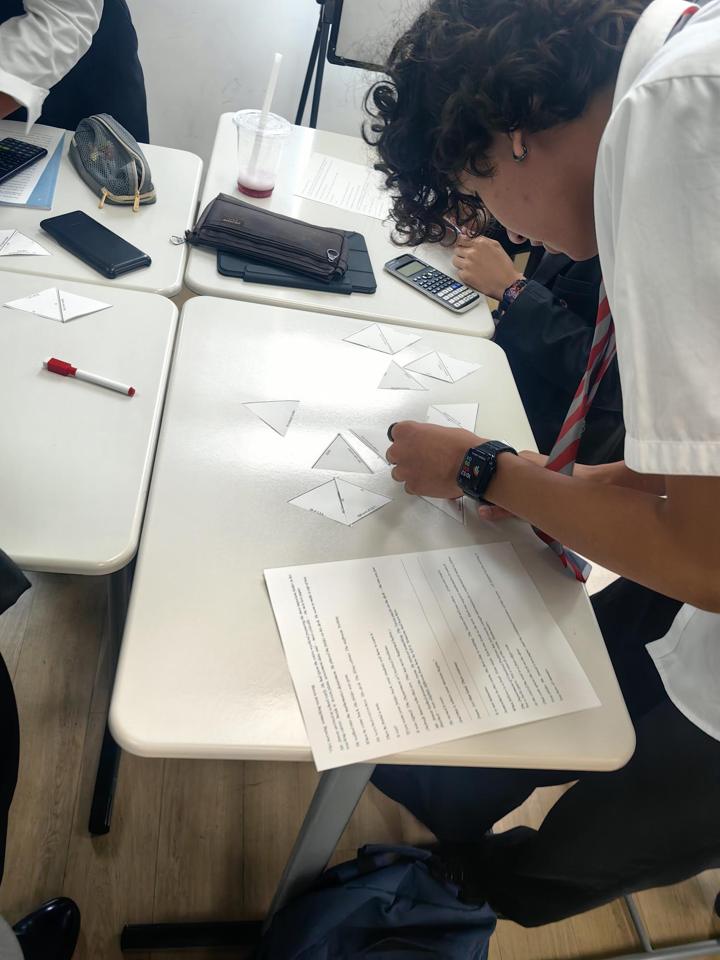
A student arranging maths cards

Card sorts and puzzles

What it looks like
Students match, order or assemble cards: equations to graphs, steps of a proof into order, or Tarsia-style triangle puzzles.
Why it works
Physically moving cards turns recall into reasoning: students have to justify every match and debate the ones that don't fit.

In my classroom: a card task where students match algebraic expressions to their equivalent forms before we discuss the tricky pairs.

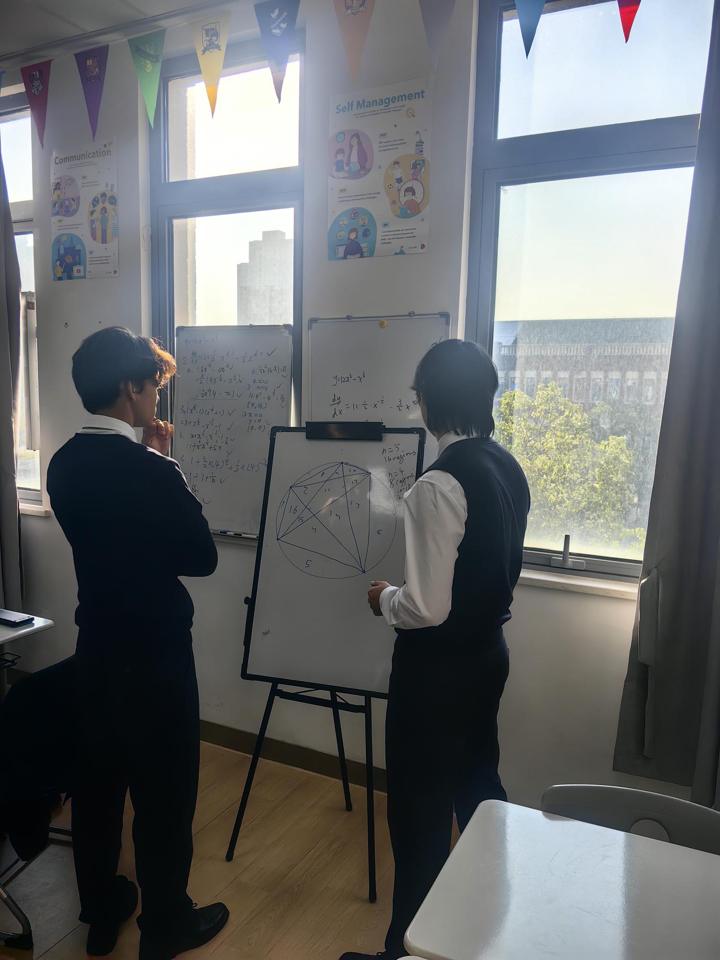
Two students solving a problem at an easel

Pair problem-solving

What it looks like
Two students share one problem: one writes, the other explains, then they swap roles on the next part.
Why it works
Explaining a method to a partner exposes gaps in understanding quickly and builds mathematical language.

In my classroom: pairs at the easel tackle an exam-style question, swapping the pen at each step.

Inquiry prompts

What it looks like
A mathematical statement on the board that students explore, test with examples and try to prove, extend or disprove.
Why it works
Students generate the questions themselves, so they own the mathematics and remember it.

In my classroom: “The derivative of a product is the product of the derivatives.” Students test it with examples, find it fails and discover the product rule.

Gallery walks

What it looks like
Groups post their solutions around the room, then rotate to read, question and add sticky-note feedback to other groups' work.
Why it works
Students see several valid methods side by side and learn to give precise, kind feedback.

In my classroom: after a modelling task, groups compare different ways of setting up the same equation.

Differentiation and feedback

Every student is stretched from where they are, and I know within minutes who needs what.

Bronze, Silver and Gold tasks

What it looks like
Each worksheet has three tiers of challenge; students start where they are confident and move up as they succeed.
Why it works
Everyone works on the same topic at the right level of difficulty, and students learn to choose challenge for themselves.

In my classroom: a binomial expansion worksheet with Bronze, Silver and Gold sections, plus full model solutions for self-checking.

Mini-whiteboard checks

What it looks like
Every student writes an answer and holds it up at the same moment.
Why it works
I see the whole class's understanding at once and can reteach or move on immediately.

In my classroom: quick checks during a lesson on logarithms before students move to independent practice.

Retrieval starters

What it looks like
Each lesson opens with a short question on earlier topics, already on the board as students walk in.
Why it works
Regular low-stakes recall strengthens long-term memory and settles the class straight into mathematics.

In my classroom: a class starter recalling the binomial theorem before we extend it to new expansions.

Exit tickets

What it looks like
One or two questions at the end of the lesson, answered on a slip or online form.
Why it works
They tell me who is ready to move on and shape the start of the next lesson.

In my classroom: an exit question on today's integration technique, sorted into “secure”, “nearly” and “not yet” piles to plan the next lesson.

Error analysis and model answers

What it looks like
Students mark worked solutions that contain planted mistakes, and compare their own work against model answers.
Why it works
Finding someone else's error is safer than finding your own, and it builds the habit of checking.

In my classroom: students correct a flawed exam answer, then use the mark scheme to see where marks are won and lost.

Independence and technology

Students become confident, independent mathematicians who can use the tools of the subject well.

GeoGebra and Desmos

What it looks like
Dynamic graphs with sliders that students manipulate to see how parameters change a function.
Why it works
Seeing a graph move as a value changes builds intuition that algebra alone can't.

In my classroom: students explore transformations of functions with sliders and write their own rules for each shift and stretch.

TI-Nspire CAS calculators

What it looks like
Explicit teaching of calculator skills for graphing, solving and statistics, matched to exam requirements.
Why it works
Confident calculator use saves time in exams and lets students check their algebra.

In my classroom: short skills sessions on finding intersections and statistical measures with the GDC.

Self-regulated learning

What it looks like
Students plan their revision, monitor progress against learning objectives and reflect on what worked.
Why it works
Students who manage their own learning keep improving between lessons, not just during them.

In my classroom: topic checklists and reflection prompts that students complete before and after each assessment.

Real-world modelling

What it looks like
Open problems built on real data, where students choose a model, test it and evaluate its limits.
Why it works
Modelling shows why mathematics matters, and builds the skills students need for the IB internal assessment.

In my classroom: students fit functions to real-world data sets and judge which model fits best.

Students as teachers

What it looks like
Students prepare and teach a short method or worked example to a small group or the whole class.
Why it works
Explaining mathematics to others is one of the strongest ways to understand it deeply, and it builds confidence.

In my classroom: pairs each prepare one type of integration question and teach it to another pair, who then set them a question to check.

Exam readiness

Strong results come from knowing the content and knowing how examiners think.

Exam-skills workshops

What it looks like
After-school crash courses and timed practice sessions before key examinations.
Why it works
Focused, timed practice builds exam technique and confidence when it matters most.

In my classroom: a G11 after-school crash course with exam-style practice sessions before the winter examinations.

Topic-based past-paper booklets

What it looks like
Past-paper questions grouped by topic and difficulty, with mark schemes.
Why it works
Students practise exactly the question types they find hardest and see how marks are awarded.

In my classroom: past-paper booklets for each Pure Mathematics topic used for homework and revision.

IA support sessions

What it looks like
Structured support for the IB Mathematics internal assessment, from choosing a topic to the final draft.
Why it works
Clear milestones and feedback help students produce independent, high-quality explorations.

In my classroom: after-school sessions guiding G12 students through their first drafts.

Mock exams with personal feedback

What it looks like
Full timed mock papers under exam conditions, followed by individual feedback on where marks were lost.
Why it works
Students experience real exam pressure early and leave with a clear, personal list of what to fix.

In my classroom: after each mock, students receive a breakdown by topic and a short follow-up task for their weakest area.

Revision checklists and trackers

What it looks like
Topic-by-topic checklists where students rate their confidence and track progress over the year.
Why it works
Students see exactly what they know and what to revise next, so revision is focused rather than random.

In my classroom: students update a topic tracker after each test and choose their revision tasks from it.

Language support for EAL learners

Most of my students learn mathematics in their second or third language. I am trained in teaching ESL students in the mainstream classroom, and I plan language support into every lesson so that English is a bridge to the mathematics, not a barrier.

Pre-teaching key vocabulary

New terms such as asymptote, discriminant or gradient are introduced with a picture and an example before the lesson needs them.

Command terms taught explicitly

We unpack what “show that”, “hence”, “state” and “justify” ask for, with model answers for each.

Sentence stems and maths talk

Displayed stems such as “I agree because…” and “This works because…” help students explain their reasoning aloud in English.

Modelled written solutions

I write full worked solutions live, narrating the language as well as the steps, then students write their own using the same structure.

Unpacking word problems

Students highlight key information, draw the situation and rewrite the question in their own words before solving it.

Higher-order thinking

I plan lessons and questions with Bloom’s taxonomy so students climb from recalling facts to analysing, evaluating and creating mathematics of their own. Every topic is taught across all six levels — here is one example on quadratics.

  1. RememberState, recall, list

    State the quadratic formula.

  2. UnderstandExplain, describe

    Explain why a negative discriminant means there are no real roots.

  3. ApplySolve, calculate, use

    Solve 2x² − 5x − 3 = 0.

  4. AnalyseCompare, deduce, identify

    Decide which of three graphs shows y = −(x − 1)² + 4, and justify your choice.

  5. EvaluateJudge, critique, justify

    Two students found the vertex differently. Which method is more efficient, and why?

  6. CreateDesign, construct, generalise

    Write a quadratic with vertex (2, −3) that passes through (0, 1).

Lower-order skills ←→ Higher-order skills

Questioning that climbs

I prepare question stems for each level, so I can push a student who has the answer to explain, compare or generalise it.

Gold tasks reach the top

The Gold tier of my Bronze/Silver/Gold tasks is written at the analyse, evaluate and create levels, not just harder calculations.

Linked to IB command terms

Students learn what “show that”, “hence”, “justify” and “interpret” demand, so higher-order thinking turns into exam marks.

Let's talk

Open to Mathematics teaching and leadership roles in international schools in China.

Phone+86 188 5151 5387